-
 Krishan Bedi came to the United States in December of 1961 at the tender age of twenty. He had only $300 in his pocket, and he had made it out of his small village in India on sheer faith, determined to get education in the US. For him, there was no option but to succeed—so he began his new life in Knoxville, Tennessee, where he had to adapt to the culture shock not only of being in the US but a Punjabi man in the South in the 1960s. Engineering a Life is an examination of Bedi’s life, and how he has handled the plethora of curve balls thrown his way with determination, humor, and an unwavering faith that everything would work out. This is a book about values and faith and the importance of friendship, family, and hard work. It’s a story about achieving the American Dream, proving that no matter how thoroughly you map out your life’s journey, no matter how many blueprints you draw up, when you veer off the course you’ve plotted—as we all do, somehow, in the end—you end up where you’re supposed to be.
 -

After a lifetime of seeking all things spiritual, wellness, and at times woo-woo, Paige Davis finds herself facing a breast cancer diagnosis at thirty-eight years old. But she quickly realizes that cancer isn’t her crisis point; rather, it is a landing pad of experiences inviting her to integrate her mind, body, and spirit, find peace in the present moment, and heal from the inside out. She embraces cancer through a lens of love rather than as a battle to be fought.
In Here We Grow, Davis provides a refreshing new paradigm of integrative living that doesn’t deny the hardship of a situation, but instead encourages meeting difficulty through embodied heart-centered presence. Utilizing mindfulness, meditation, and mind-body disciplines, she shares a tool kit for transformation as she learns to befriend her body, cope through compassion, face survivor’s guilt, create a “new normal” post treatment, and discover the unexpected awakening of intuition and open-heartedness in the healing journey. Filled with honesty, humor, and present-moment awareness that reveals our true capacity for joy, connection, grace, and resilience, Here We Grow is Davis’s story of meeting fear and uncertainty with mindfulness, meaning, and the unconditional love inherent in us all. -
 Indiana University, September 1963. Meri Henriques, a naïve freshman from New York, arrives on campus thinking she’s about to enroll at an idyllic Midwestern college. Instead, she discovers a storm is brewing. An intriguing cast of characters inhabits Meri’s new and often troubled world: Katherine “Pixie” Gates, Meri’s charming and quirky roommate; Rose, brilliant and sarcastic fellow New Yorker; Daniel, a tough radical with a tender heart; folk singer Derek Stone, Meri’s heartthrob crush; and Shennandoah Waters, a white coed who only dates black men or exotic foreigners, much to her ultra-conservative parents’ horror. Over the course of Meri’s first year at college, tragedy strikes twice: John Kennedy is assassinated, and a young, black IU basketball player is castrated and thrown into a ditch—murdered for dating a white coed. And finally, that year’s commencement ceremonies bring an infamous symbol of white supremacy to campus, endangering anyone who dared to protest—thrusting Meri into the middle of violent and escalating racial tensions. Vivid and compelling, Hoosier Hysteria is a timely story of prejudice and political unrest that, today more than ever before, must be told.
 -
 “Who do you thank you are, the Quane of Anglund?” That’s what Grace Marie’s father used tosay to her whenever he thought she was getting out of her place. In her fifties now, Grace Marie is a college professor living in a beach town in California, and when she gets a phone call telling her that her father is dead, she is glad. She hopes her return for his funeral will be her “last trip home.” As a young girl Grace Marie struggled to escape from poverty, her father’s lecherous, controlling grip, and a husband in the Klan. Determined to get an education, she clawed her way to a comfortable life and a home with indoor toilets—but her most unexpected struggle turned out to be survivor’s guilt, so she kept returning home to “fix” her family and the sharecropper shack. After her father’s funeral, Grace Marie burns down the family home—only to discover that she has unexpected ties to both the land and the people in her community. She realizes she will never have a “last trip home.”
 -
 In the 1980s and 1990s, a mind-boggling social panic over child sex abuse swept through the country, landing childcare workers in prison and leading hundreds of women to begin recalling episodes of satanic ritual abuse and childhood abuse by family members. Now I Can See the Moon: A Memoir is a deeply personal account of the devastating impact the panic had on one family. In trying to understand the suicide of her twenty-three-year-old niece, a victim of the panic, the author discovers that what she thought was an isolated tragedy was, in fact, part of a much larger social phenomenon that sucked in individuals from all walks of life, convincing them to believe the unbelievable and embrace the most aberrant claims as truth.
 -

No one could have imagined how as a child Beverly Engel could have managed to become who she is today—an internationally known expert on abuse recovery and the best-selling author of twenty-two self-help books. This is the raw, candid story of how she made her way in the world in spite of her mother’s neglect, unreasonable expectations and constant criticism; in spite of being sexually abused, first at four years old and then at nine; and in spite of being raped at twelve.
Raising Myself takes readers on a remarkable journey, showing us how Engel, who was basically on her own from the age of four, learned how to cope with a neglectful, narcissistic mother while being surrounded by a cast of characters that included eccentrics and misfits, a religious fanatic, child molesters, rapists, and hoodlums. It is a soul-searching memoir about how she came dangerously close to the edge of becoming a child molester, a criminal, and a suicide, and how she battled her inner demons and struggled to keep her heart open and to “reinvent” herself so she could follow her dream of making something of herself. Powerfully inspiring and unflinchingly honest, Raising Myself is a story of remarkable resilience and insight. -
 Most honeymoons, Mary knows, do not start this way. Lying outside on the sloping attic roof in Edinburgh, listening to the soft snores of her groom, she realizes that Rudy’s number one rule, “adapt,’ once again reigns. Rudy’s Rules for Travel takes you across the twentieth-century globe with intrepid, frugal Rudy and his spouse Mary, a catastrophic thinker seeking comfort. Whether stalled in a Spanish car tunnel, stranded atop a runaway elephant, or held at rifle-point at a Soviet border, Rudy has a rule for every occasion—for example, “Relax, some kind stranger will appear.” Mary, meanwhile, has her deep breathing and her own commandment: “Expect the worst.” The two are a picture of contrast. As Mary was being born, Rudy was a new American citizen flying US Air Force missions over his homeland, Germany. His father was a seaman, hers an accountant. And when this marriage of opposites goes traveling, their stories combine laugh-out-loud humor with poignant lessons from the odyssey of a World War II veteran. So start packing—you’ll want to join these two.
 -
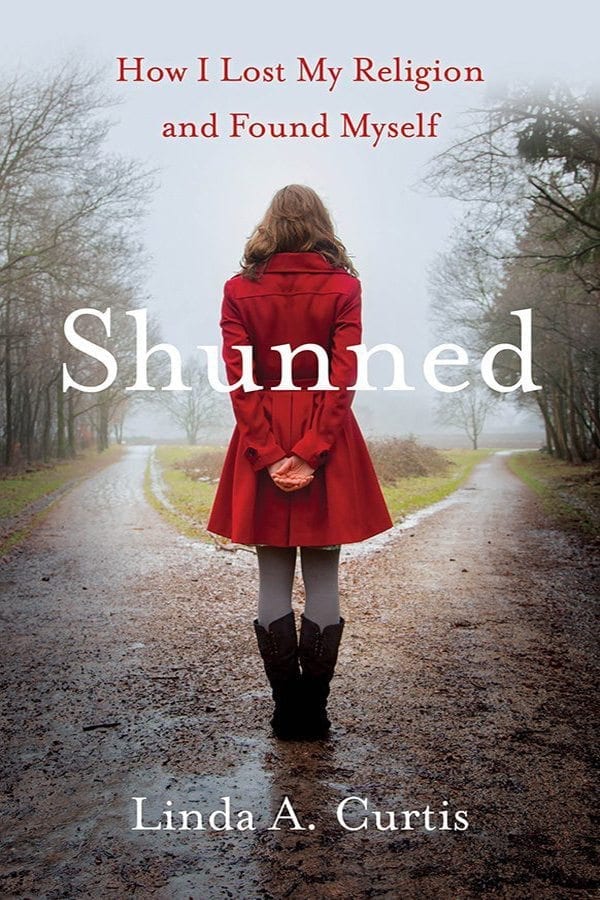 Linda Curtis was raised as a Jehovah’s Witness and is an unquestioning true believer who has knocked on doors from the time she was nine years old. Like other Witnesses, she has been discouraged from pursuing a career, higher education, or even voting, and her friendships are limited to the Witness community. Then one day, at age thirty-three, she knocks on a door—and a coworker she deeply respects answers the door. To their mutual consternation she launches into her usual spiel, but this time, for the first time ever, the message sounds hollow. In the months that follow, Curtis tries hard to overcome the doubts that spring from that doorstep encounter, knowing they could upend her “safe” existence. But ultimately, unable to reconcile her incredulity, she leaves her religion and divorces her Witness husband—a choice for which she is shunned by the entire community, including all members of her immediate family. Shunned follows Linda as she steps into a world she was taught to fear and discovers what is possible when we stay true to our hearts, even when it means disappointing those we love.
 -
 This book isn’t just about being in business; it’s about the business of being. But when you stop to think about it, each of us is like a small business. Successful business owners implement strategies that improve their prospects for success. Similarly, as human beings, it serves us well to implement guiding principles that inspire us to live our purpose and reach our goals. The rich ganache filling that flows through the center of this book is the story of La Mandarine Bleue, a delicious depiction of how nine individuals used twelve steps of a business plan to find their vocation and undergo a transformation (with some French recipes thrown in for good measure). From a business plan and metrics to mission and goals with everything between—investors, clients and customers, marketing strategies, and goodwill development—this book clearly maps how to create personal transformation at the intersection of business and spirituality. Merging the language of business and self-help, The Business of Being will teach you how to enhance “profitability”—body, mind, and spirit.
 -
 One summer afternoon in northern England in 1946, when Ann Colley was a child, she met a man from Czechoslovakia named Dr. Novak. This encounter launched her lifelong fascination with Central and Eastern Europe, one that resulted in her spending two years, in 1995 and 2000, teaching at universities in Poland and Ukraine. In The Odyssey and Dr. Novak, Colley records personal experiences, interactions with colleagues, and descriptions of the landscape, creating a composite portrait of these countries at a time when each is struggling to chart its course after the collapse of the Soviet Union in 1991. She recalls moments that are disturbing, absurd, discordant, frustrating, humorous, and endearing – a missing parrot flying through the window, a robber on a train threatening her life, clouds of smoke from Chernobyl hanging over Kiev. Colley’s journey ends with her return to the figure of Dr. Novak when she searches in the archives of the Harvard Divinity School Library for letters sent from Prague in 1945 – letters which, just like her memoir, speak of a past that pursues the present.
 -

In The Trail to Tincup: Love Stories at Life’s End, a psychologist reckons with the loss of four family members within a span of two years. Hocker works backward into the lives of these people and forward into the values, perspective, and qualities they bestowed before and after leaving. Following the trail to their common gravesite in Tincup, Colorado, she remembers and recounts decisive stories and delves into artifacts, journals, and her own dreams. In the process the grip of grief begins to lessen, death braids its way into life, and life informs the losses with abiding connections. Gradually, she begins to find herself capable of imagining life without her sister and best friend. Toward the end of the book Hocker’s own near-death experience illuminates how familiarity with her individual mortality helps her live with joy, confidence, and openness.
-
 Mandy Stadtmiller comes to Manhattan in 2005, newly divorced, thirty years old, with a job at the New York Post, ready to conquer the city, the industry, and love in one fell swoop. Like a “real-life Carrie Bradshaw” (so called by Jenny McCarthy), she proceeds to chronicle her fearless attempts for nearly a decade in the Post, xoJane, and New York magazine. But underneath the glitz and glamour of her new life, there is a darker side threatening to surface. Mandy goes through numerous unsuccessful, high-profile hookups in the New York comedy and writing scene. There are soon too many nights she can't remember, and the blind spots start to add up. She begins to realize that falling in love won't fix her—she needs to fix herself first.